Showing posts with label americana. Show all posts

Tuesday, October 4

10E2568: Pennsylvania Tuxedo - Woolrich x Dogfish Head

"Pennsylvania Tuxedo is a spruce-infused pale ale whose name pays homage to the red and black plaid wool outfits traditionally worn by hunters in the deep woods of Pennsylvania" [where pencils come from - ed].

Woolrich and Dogfish Head are teaming up again. Pennsylvania Tuxedo, a pale ale brewed with spruce tips will begin shipping nationwide on October 24, 2016. The clothing line, which features  “Dogfish Head Plaid” flannels for both genders, caps, blankets, and neat doo-dads - will also be available.


The idea behind the collaboration was inspired by a story from the mid-19th century when Michael Bond Rich, grandson of Woolrich founder, John Rich, had an unforgettable encounter with spruce beer. The incident occurred when his father was hosting a barn raising. The young M.B. Rich recalled, “On account of rain on the day set, the raising was postponed a couple of days and the spruce beer which was prepared had acquired a potency not intended. As it was accessible to me, I drank quite freely and, when later on I stooped over to get a drink from the spring, I fell in headfirst and was too much intoxicated to get out.”
Luckily, M.B. Rich was saved by a woman who happened to be fetching water from the spring, and the young boy lived to tell the story that helped Dogfish Head create Pennsylvania Tuxedo.


If you have not checked out Woolrich lately or had perhaps forgotten about their other lines - have a second look.  Everyone involved obv had a ton of fun with this. Good stuff, via Dogfish Head.

Monday, February 27

council tool -"velvicut" hudson bay axe making video


Narrated by Council Tool president John Council, this video reveals a few key details (ribs inside the axe head to grip the handle); "just like it ought to be".

Have mentioned them before; Council Tool provide axe heads to Best Made and I believe also for newish marque in Montana called Meriweather Field Gear, who specialise in maple/walnut laminates for the helves. They use a similar process to produce eye-watering canoe paddles, w/ carbon faces for kayak paddles; as WhiskeyJack Paddles). Pretty stunning.


Tuesday, December 6

reblog -carmex


"Alfred Woelbing was a buyer at a Chicago department store back in 1937, but he didn’t much like working in the big city. So he began his own business, making silver polish in the basement of his home in Wauwatosa, Wisconsin. It paid the bills, for the time being.

Alfred then decided to create a home remedy for a pesky condition that he’d often suffered: cold sores. After much experimentation over a hot plate, Alfred created Carmex, and then proceeded to sell it to pharmacies by going door to door. If they weren’t interested in purchasing his product, he gave them a dozen jars for free—along with a post card for a re-order. He figured that if he could sell one jar at every drug store in Milwaukee and Chicago, he and his wife could make a decent living.

It wasn’t long before Alfred’s home-based business was booming. Apart from a wartime hiatus in production due to lanolin rationing, Alfred’s company—now known as Carma Labs—grew steadily. For 35 years, Alfred made sales calls in Wisconsin, Illinois and parts of Indiana. He remained president of the company until his death in May, 2001...

Alfred died at age 100. Up until the age of 96, Alfred worked 8-hours a day, driving over 40 miles to get to work. Even after he stopped his daily routine, his presence was still felt. His son and grandsons continue the Carmex lip balm tradition today."
-paraphrased from MyCarmex.
Iconic original jar imho, though no shock that the original cold sore purpose slightly downplayed in the jar's later iteration as below. Slight irony alert that a product to treat cold sores can help spread them if you use an infected person's jar... I guess "don't share" is the answer at all times. Anyone else keep a jar in the glovey that either melts in summer or is rock hard in winter? I should probably rethink that habit.

The tubes (introduced in 1988) might be easier to work with in winter but something about the milky glass of the jars is so great. The smell is pleasant and the mouth feel is tingly due to camphor and menthol. Further ingredients.

Wednesday, October 13

forest service/usda historic photos

Historic photos from the USDA Forest Service collection. The cataloging is inconsistent; sometimes the title is a subject (recreation-hiking), sometimes a description (This patrol starts for the climb...) or sometimes just the filing name (photo 212141). I have picked between description and title fields below. Majority from the Pacific NW. Almost 4,000 images so far; get lost... All photo credits to U.S. Forest Service.

Hikers on Jefferson Park Tr., Mt. Jefferson Primitive Area.
CCC trapper, A. Schueneman and Wolf. Credit: Archibold
Ten year old boy's catch. Crecent Lake.
Members of Conscientious Objectors camp demonstrating 'one-lick method' of fire line building for Forest Service Reserves. Larch Mountain.
CCC Maintenance work on Swan Lake Road
Low Echo Girl Scout camp on east shore of Lake of the Woods. Medford girls learn camp cooking as part of training program.
Zigzag River - picking up a few old ones.
Small fry trying their luck at fishing near the dock at Tee Harbor while their parents are out fishing in the 1958 Juneau Salmon Derby. Credit: Prater
Trout fishing Karta River near Ketchikan, Alaska

Wednesday, September 22

from stump to ship

I had heard about, and seen VHS copies of this historical document From Stump To Ship for a few years and not sure why never watched it. It is online though, 28 minutes, as below. The added narration explains (Maine humourist Tim Sample keeping it restrained) that Alfred Ames, the then president of Maine's Machias Lumber Company brought his camera out to the logging camps and the river drive to document the goings on. Priceless stuff.

This is 1930 and already the trees felled are not as big as in years gone by (we learn)... but the fortitude and agility of these guys is pretty inspiring. Lots of historical terminolgy and info; caulked boots from Bass in Wilton, ME? Yup. Anyone slightly interested has probably seen this already -some pieces of it are used in Woodsmen and River Drivers, another documentary on old loggers from the Machias Lumber Co. but more recent. Great stuff too.

Tuesday, July 27

orvis -us patent

You can follow the bouncing ball on these USPatent posts but got my hands on a copy of the catalog and wanted to share my 2cents.

Quick backstory, this special catalog from Orvis, the famed rod/gun/outfitter, is entirely made up of US-made products. Some are iconic (Schott Peacoat) some are more niche (Stronghold gear, Gitman shirts), some were specially made (Miner's pant). Full disclosure; note that I grew up near Manchester, VT so v familiar w/ Orvis and tangentially know some employees there.

Not going to lie, most of the collection is a little rich for me but have to admire the thinking that has gone into this. Also glad Orvis kept the copy relatively jingo-free. Available in August.

Vintage 1951 Ford F-1. This vintage pickup truck was subjected to a meticulous frameoff restoration resulting in a truck that looks exactly as it did when it rolled off the assembly line nearly 60 years ago. Sheridan blue/gray. Fully restored V-8 engine, solid oak bed boards. $67,500. [this is in the dictionary under don't sleep or maybe lottery]


Whipcord Trousers. Tailored in Greenpoint, New York, these poly/wool whipcord pants [love whipcord] have a forward facing pleated front with an additional interior French-tab closure [not usually a pleats fan but the watch pocket almost negates them here]. Pockets have leather trim [love that -ed.], button-through rear pockets. $298


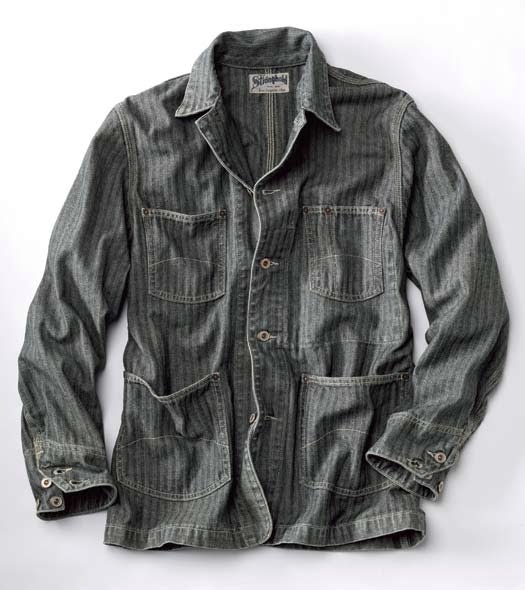
The Stronghold, one of the original American denim-workwear companies, was founded in 1895 —when The Orvis Company was just 39 years old... The Stronghold® Denim Chore Coat is crafted from sturdy 11.5-oz. herringbone (aka fisher stripe) pure cotton denim; features four front pockets, a pen slot, and one interior pocket. Adjustable cuffs. $445.


Flannel Shirt. Crafted in Fall River, Massachusetts —once home to a thriving garment industry where vacant factories are gradually returning to life. Soft-brushed flannel and casual styling. Spread collar. [have never seen a gingham flannel -ed.] $149

Rising Sun Miner’s Pants. [These might be the most pined for item already; hit the image to see it way bigger. Can't confirm it in b&w but assume RisingSunJeans are behind this]. Crafted in Pasadena, CA using American cotton denim twill, these work pants are given a thoroughly broken-in look. [cue obligatory backstory -ed.] A pair of early 20thC pants found in a California mining camp provided inspiration for traditional details, including front and rear patch pockets, button fly, and adjustable-buckle back. Right-front coin pocket. Denim-lined waistband. Wheat color. $189. #nails.


Oxford-Cloth Tartan Shirt. Made in Ashland, PA by The Gitman Company (1948). Garment washed. Chest pocket. Single-button cuff. [like that navy/white/yellow] $149.

Hill Climber Jacket. Taylor Supply® crafts this heirloom-quality waxed pure cotton jacket. Shawl collar with soft wool lining, four outside pockets, adjustable waist and back straps, button front closure, and adjustable gusseted cuffs. Fully lined. Wool cuff and pocket-flap linings. Runs small. Wipe clean with damp sponge. $495 [this is actually available now]

Monday, July 26

north star glove co.

There are several aged American canvas-work-gloves manufacturers still in existence today (e.g. Galeton, Brookville), but July marked the centennial of Washington state's North Star Glove Company.

North Star produces “cut & sewn” types of canvas and/or leather work gloves in a multitude of patterns and variations. This selection of USA made gloves gets sold predominantly in the western states, Alaska and Canada, and the Southeastern lumber producing states. The family-owned, Tacoma WA-based company manufactured its first pair of gloves on July 9, 1910 and recently celebrated its centennial, quietly. They graciously answered my request for more info and some images; which I have paraphrased below.

The company was founded by Albert Wekell (seen above), a sturdy and adventurous Swede. Wekell arrived in Tacoma from Sweden around 1890 and ventured out to Alaska and the Yukon in the early 1900s Gold Rush. He didn't find his wealth there, however struck it rich by playing cards on the riverboats and steamers with successful miners and ship captains on his return to Seattle.

With that start, young Albert bought some machines and material to start North Star Manufacturing in Tacoma. Serving mostly the logging trade of the area, he would ride the local trolley car to the commercial wilderness out along McKinley Avenue where the logging camps started and sell his gloves to the merchants set up nearby. With that money he would return to town and buy new material to make even more gloves; thus pushing his selling territory out further and further.

Fast forward to 2010; the company remains in the family managed by corporate President Rob Wekell and brother Tom -Albert’s grandnephews. Further reading.

Over the past century, America could count at least a thousand glove manufacturers. Today, according to Rob Wekell, there are now barely a hundred – as small plants have been subsumed by larger companies, or moved offshore where labor and materials were cheaper, or simply closed.

“World War I was the first hit,” said Rob. “In World War II, we didn’t have enough people to work.” In 1944, the company opened a manufacturing plant in Orting and hired local women to sew and assemble gloves. Said Tom, “If you couldn’t make money in the Fifties, you shouldn’t have been in business.”

Thousands of jobs have disappeared in the last 10 years in the Northwest. That includes aluminium, lumber and plywood jobs. “During a recession, we go back to our basic product lines. People go back to the basics.”, Rob says. That means basic products; for example their White Ox brand canvas glove, produced since 1933.


Billed as The most popular glove in the Pacific Northwest The White Ox work glove has been used by loggers and woodsman has known for over 70 years.

  • 100% cotton; fourchette pattern (material sewn between the fingers)
  • Double ply quilted palm equates to construction from 22oz canvas
  • 10 oz. canvas smooth back; knitwrist
  • Fuzzy nap both inside and outside
Why so popular though? Part of the reason is price (around $7 a pair); the intelligently configured cotton affords near leather safety, but for the price of canvas. Some also prefer cotton to leather as they feel it grips better in the wet conditions of the NW. Sidenote: really like the classic stamped-red, simple branding on these and other gloves of their ilk (more). An updated version has a red wrist strap, as below.


Fun fact: Due to various factors, including hiring practices, glove sizes have changed over the past 100 years. Where the U.S. Forest Service once ordered gloves in two sizes – Big and Bigger – the agency now buys seven sizes, including small.

Again, thx to Rob Wekell (and Sherry) for providing text and images.

Thursday, July 8

late to the party -eric sloane


Have had this fantastic book An Age of Barns for a few years, nabbed it from Pops, but just now started to dig around the late author/illustrator Eric Sloane. This post will barely scrape the surface of his work but hopefully an fyi. Bio below paraphrased from SloaneAwareness and EricSloane. Usually don't post huge chunks like this but good stuff...
Born Everard Jean Hinrichs in New York City (1905) he later changed his name to Eric to reflect his American origins —he pulled "eric" from the middle letters of America and choose Sloane in reverence to John Sloan, a leading figure in the Ashcan School of realist artists. An early interest in art was sparked by neighbors Herman Roundtree (illustrator for Field & Stream) and noted font inventor, Frederic W. Goudy. Hand-painted letters and signs feature prominently in Sloane's illustrated books.

Some of his first clients included aviation pioneers flying out of Roosevelt Field, Long Island who asked him to paint the identifying markings on their planes. In exchange for painting lessons, Wiley Post taught the young Hinrichs to fly. Clouds and the sky would become central themes to his work. Among his early clients was Amelia Erhardt, who apparently bought his first cloud painting. His largest cloud painting graces an entire wall of the Smithsonian Air and Space Museum in Washington DC.

After a falling out with his family, young Sloane ran away to become an itinerant sign painter. He worked his way across America, creating advertisements and painting signs on barns, buildings and stores.

A deepening interest in weather caused Eric to enroll in the Massachusetts Institute of Technology’s meteorology program, but he left that program after becoming discouraged with the amount of mathematics needed. One of his professors half-jokingly suggested that Eric was looking for “romance” in the weather and would not find it at M.I.T. -stating he would be better off reading the almanacs and weather diaries of the early American farmer. It was a suggestion that would prove to be pivotal in the artist’s life and career. [This next part goes out to the FieldNotes crowd -ed] Taking the likely tongue-in-cheek comment of his professor seriously, Sloane began placing advertisements in Yankee Magazine to purchase farm diaries, journals and almanacs, and soon his living room was overflowing with tattered books and musty smells. As he read he indeed found the romance in weather he was looking for - descriptions of "violent" showers and "sudden" storms that cleared with a "sweet smelling aire".

Fascinated by weather, The Farmer's Almanac and the early American farmer's ability interpret "weather signs", Sloane is even credited with being the first television weatherman... He came up with the idea of having farmers from all over New England call in their weather observations to a Dumont, New York TV station where they could be broadcast to the regional audience.

Eric Sloane found more in those almanac pages... he became fascinated by the life of the early American farmer as he read of their knowledge of wood, the seasons, the stars.

While restoring a Connecticut farmhouse in the early 1950's he began to further investigate the Early American settlers and concentrate on their building techniques. In 1956 he moved to Warren CT, where he kept a home until 1985. At a Warren Library book sale he is said to have found an account of New England farm life in the 1800's by one Noah Blake; that diary became the framework for Sloane's most successful book, Diary of an Early American Boy.

Eric Sloane may arguably be the foremost authority on Early American rural architecture and Early American tools. His book A Museum of Early American Tools is considered an important source work on the subject. The Sloane Stanley Museum in Kent, CT houses Sloane's own personal collection of Early American tools -adding it to my list now.

Another book, A Reverence for Wood is an invaluable resource to scholars of old growth timber in New England, covering such topics as; the aesthetics of wood, wooden implements, and carpentry. Slone remarks with affection on the resourcefulness of early Americans in their use of this precious commodity. Some nice person has scanned Reverence and posted it. Get in there.

Over his lifetime Eric Sloane wrote over thirty books and estimated that he created nearly 15,000 paintings. He must have painted one almost every day...

Phew... Long/short I am eating this stuff up. The line drawings and lettering style are not for everyone but you have to admire his drafting skills. The more colorful barn paintings that have been reprinted ad infinitum may seem slightly cheesy (touse the academic term) but only because they have since been co-opted as a quintessential New England barnscape default. I'll go to the mat for the washed out ones though, all greys and old shingles.

Our copy has a different cover and sure could post pages all day... Last year I noticed UVM had started a Vermont Barn Census, Sloane's book below has to be essential reading for that.


"Few buildings of the past remain to speak as plainly of the early American economy as the old stone farm buildings."
-Eric Sloane, I Remember America, 1971.


Tuesday, July 6

levis x braddock pa

Levi's have launched a new campaign titled Ready To Work; quote via Levis below.
The muse for Levi’s® new campaign is Braddock [Pennsylvania; the film location for The Road infact -ed.], a town embodying the demise of the blue collar base that is taking radical steps to reverse its decay. Braddock now faces a new frontier of repurpose and new work in what was once a flourishing industrial mecca. Since 2001, John Fetterman, the mayor of Braddock, has taken his fight for social justice in Braddock to the masses by enlisting the help of modern pioneers – artists, craftsmen, musicians and business owners – to rebuild and revive the town. As it rebuilds, Braddock has become a model for how any city, in any part of the country, can prevail as a symbol of hope and change.

To contribute to the real change in Braddock, the Levi’s® brand is committed to funding the refurbishment of Braddock’s community center, a focal point of the town and their youth-based programming. Additionally, Levi’s® is supporting Braddock’s urban farm which supplies produce to local area residents at reduced costs.
Some powerful stuff in the 2 video updates below and good on them for putting money into these efforts. I am really not a fan of the other side of this campaign though, the slightly poverty-porn To Work video. Watch that here.


New-ish releases from Levi's include some trucker jackets, (none that they could not resist tampering with; the official line can't be "but you can buy it at JCrew" can it?? Major hats off to JCrew btw for resurrecting this stone cold 2 pocket classic), shirts and a ton of selvage-y jeans (very tasty looking and sub-$100, but not seizing the moment to have these made domestically, please correct me if wrong...) Close to a home run.


Might not be fair to them but I have Levi's on a bit of a pedestal as symbolic of America. The image of a pair of jeans... you don't need to tell customs officials in Russia what that means, or Bruce Springsteen (though for some reason Brits love to stock up on Calvin Klein when they come here -maybe it is because of the underwear) anyway, I can't get to the Tailor Shop or LVC pop-up stores... so have to take their public messages at face value. Just don't appreciate the admonishing of slogans like "get to work"... I like seeing THEM get to work, fine. To reiterate, philanthropic giving by Levi's is applauded here. It just feels like this money making enterprise, archived to the hilt, has a chance to ab-so-lutely crush a belt high fastball but keeps popping out on the warning track... kills me.